Wood flour mill
Also known as a wood pulverizer or high-fineness wood powder machine, this unit features a self-suction feeding mechanism that ensures operational safety. It eliminates the risks associated with traditional direct-feed crushers—such as severe machine damage caused by the accidental introduction of metal objects. Precision-engineered and manufactured using advanced techniques, the machine operates with minimal noise and vibration. It boasts an attractive, durable design and high output, offering over 50% greater efficiency than traditional models; it is an ideal pulverizing solution that currently surpasses all other similar equipment on the market.
Applications:
This machine is suitable for processing a wide range of fibrous materials, including wood powder, sawdust, bamboo powder, chestnut shell powder, elm wood powder, wood pellets, wood chips, bark pellets, camphor wood powder, cypress wood powder, dried shrimp shell powder, star anise powder, Sichuan pepper powder, chili powder, black pepper powder, refined cotton, feathers, feather quills, straw, wheat bran, rice husks, adhesive wood, potato residue, cassava, traditional Chinese medicinal herbs, fish meal, oil cakes, and magnesium trisilicate. It is an essential piece of equipment for industries such as Bakelite manufacturing, plastics, papermaking, mosquito coil and incense production, animal feed, traditional Chinese medicine, and livestock farming.
The machine operates by using an electric motor to drive the main shaft at high speeds. This converts mechanical energy into powerful impact, compression, shearing, and frictional forces acting upon the material, giving the machine unique capabilities for pulverizing fibrous substances.
Structure:
The wood powder machine consists of components for coarse crushing, fine crushing, and pneumatic conveying.
The machine body is composed of three main sections: the upper, middle, and lower housing units.
The pulverizing blade assembly consists of “7-shaped” blades, straight blades, and centrifugal blades.
The auxiliary system comprises a blower fan, a powder collector, and a dust collector.
The main crushing chamber utilizes “7-shaped” blades, straight blades, and centrifugal blades to perform coarse crushing, fine crushing, and centrifugal milling. The motor drives the pulverizer rotor to spin at high speed, generating a high-velocity airflow that subjects the material to intense impact, compression, shearing, and frictional forces, thereby achieving a unique pulverization effect.
During the cutting and pulverization process involving three types of blades, the rotor generates a high-speed airflow that rotates in the direction of the blades; the material accelerates within this airflow, undergoing repeated impact, shearing, and friction—experiencing all three pulverization actions simultaneously. The pulverized material is carried by the airflow into the classifier for separation. Because the material is subjected to both the centrifugal force of the classifier rotor and the centripetal force of the airflow, fine particles—where centrifugal force is outweighed by centripetal force—are carried into the powder collector, while coarse particles enter the centrifugal re-pulverization chamber to undergo further grinding until the desired fineness is achieved.
Wood Powder Machine Operating Principle:
When the wood powder machine is in operation, the motor drives the pulverizer rotor to spin at high speed, generating a high-velocity airflow that subjects the material to intense impact, compression, shearing, and frictional forces, thereby achieving a unique pulverization effect;
During the cutting and pulverization process involving three types of blades, the rotor generates a high-speed airflow that rotates in the direction of the blades; the material accelerates within this airflow, undergoing repeated impact, shearing, and friction—experiencing all three pulverization actions simultaneously. The pulverized material is carried by the airflow into the classifier for separation. Because the material is subjected to both the centrifugal force of the classifier rotor and the centripetal force of the airflow, fine particles—where centrifugal force is outweighed by centripetal force—are carried into the powder collector, while coarse particles enter the centrifugal re-pulverization chamber to undergo further grinding until the desired fineness is achieved.
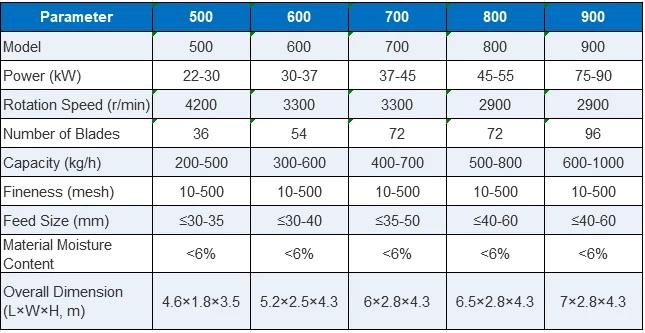
Key Specifications