Jaw Crusher
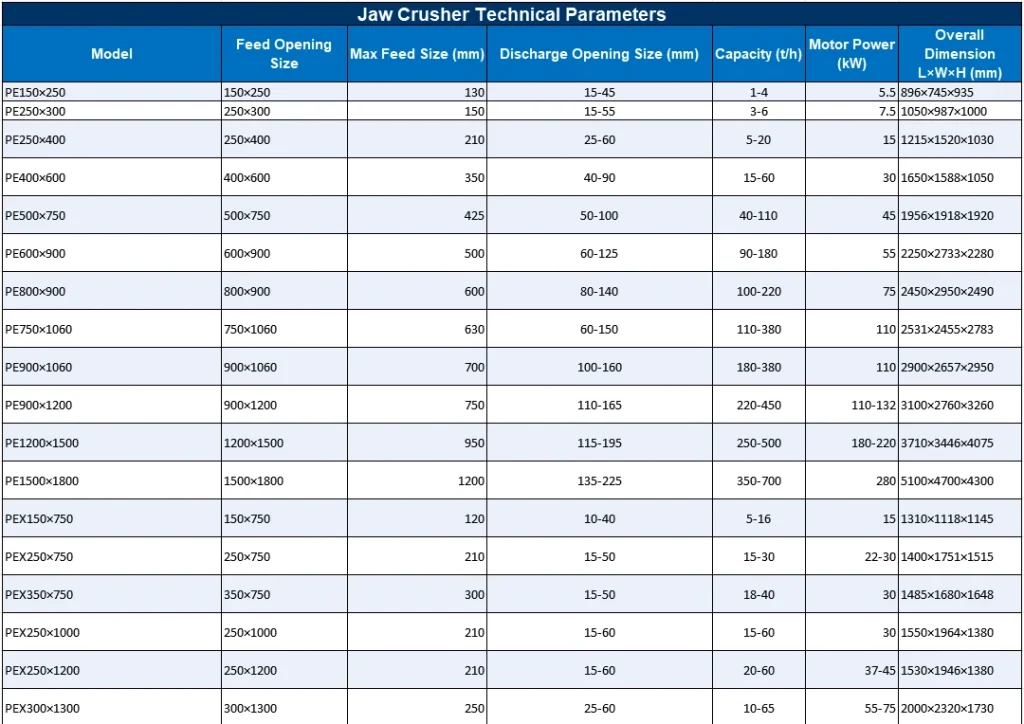
The jaw crusher is a highly efficient, energy-saving crushing machine. Available in two main types—PE (for primary/coarse crushing) and PEX (for secondary/fine crushing)—these crushers come in a full range of specifications to meet the diverse operational needs of various customers. They are widely used across industries such as mining, metallurgy, construction materials, road and railway construction, chemicals, refractories, and ceramics. They are suitable for crushing ores of varying hardness, provided the material’s compressive strength does not exceed 320 MPa and the maximum feed size remains within the limits specified in the technical parameters.
The jaw crusher is primarily composed of components such as the flywheel, guard plate, jaw plate, spring tie rod, movable jaw plate, fixed jaw plate, eccentric shaft, bearings, and frame. Featuring a rational design and compact structure, the equipment enables more convenient and efficient operation during production.
- A specialized moving jaw assembly ensures exceptional durability. The assembly features high-quality cast steel components driven by two large cast steel flywheels. Additionally, the heavy-duty eccentric shaft is machined from a forged blank; these features combine to give the JC series jaw crusher outstanding reliability.
- The bearing housing utilizes an integral cast steel structure. This one-piece design ensures a perfect fit with the crusher frame and significantly enhances radial strength—advantages not found in split-type bearing housings.
- Finite Element Analysis (FEA) technology is employed to ensure superior structural strength.
- The crushing chamber features a symmetrical “V”-shaped design, ensuring that the actual feed opening width matches the nominal width.
- Discharge opening adjustments are quick and convenient. The JC series jaw crusher is equipped with a wedge-style adjustment mechanism, which is simpler, safer, and faster than traditional shim-based systems.
The jaw crusher operates on a toggle-driven compression principle. An electric motor drives the belt and pulley, causing the movable jaw to move up and down via an eccentric shaft. As the movable jaw rises, the angle between the toggle plate and the movable jaw increases, forcing the movable jaw plate toward the fixed jaw plate; this action crushes or splits the material. When the movable jaw descends, the angle between the toggle plate and the movable jaw decreases, and the movable jaw plate—pulled by the tension rod and spring—moves away from the fixed jaw plate, allowing the crushed material to discharge from the bottom of the crushing chamber. Continuous motor rotation drives the movable jaw through this cyclic motion of crushing and discharging material, enabling mass production.
The machine should be installed in a sheltered area and, whenever possible, not outdoors.
The motor must be mounted behind the crusher. The machine is secured to a concrete foundation via four anchor bolts; the foundation must include a discharge chute with a slope of at least 50 degrees.
Small-scale experimental crushers do not require a concrete foundation or a specific discharge chute arrangement; however, they should be placed on a level floor or workbench and cushioned with a rubber pad (approximately 5 mm thick) to ensure stability and vibration dampening.
When the crusher is used in conjunction with other equipment, the layout must be planned holistically to facilitate production and ensure efficient operation.
Test runs may only commence after the crusher has been fully installed and the foundation has completely cured. Before the test run, verify that all bolts are tightened and all connecting parts are securely fitted. Next, manually rotate the pulley to ensure there is no mechanical obstruction before proceeding to a no-load test run. During the two-hour no-load test, observe the machine for any impact, abnormal noise, oil leaks at seals, wobbling of the pulley or flywheel, or loose components; also, ensure the bearing temperature rise does not exceed 65°C. If any such issues arise, the machine must be stopped immediately for inspection and repair. Once the crusher is confirmed to be operating correctly during the test run, a load test may be conducted using materials of moderate hardness or small particle size; if no faults occur, normal production may begin.
The crusher must be started under no-load conditions; before startup, carefully inspect the tightness of components, the elasticity of springs, and the tension of the drive belts. Feeding should only commence after the crusher has reached its normal operating speed. Strictly prevent iron, steel, or excessively hard rock from entering the machine to avoid damaging its components. Before shutting down, stop the feed supply and allow all material inside the machine to be discharged completely before stopping the motor.
To adjust the discharge particle size, loosen the locking screw on the adjustment handle at the rear of the machine; turn it clockwise to decrease the gap and counter-clockwise to increase it. After setting the appropriate gap, manually rotate the machine at least two full revolutions before starting the motor for operation; starting the motor immediately after adjustment without this manual rotation is strictly prohibited.
When the crushing jaw plates are severely worn and unusable, they can be flipped over for continued use. Technological advancements have introduced new methods to extend jaw plate lifespan and improve maintenance efficiency, such as bimetallic wear-resistant jaw plate surfacing repair technology (CN120791220B) and specialized tooth plate wear detection devices (CN121576879A).
To ensure long-term optimal performance, regularly apply calcium-based grease to moving mechanisms and bearings: lubricate the toggle plate/slider interface and the toggle plate/swing jaw pivot point every 15 days, and lubricate bearings every 30 days. The crusher requires annual maintenance and a major overhaul every two years. Modern equipment, such as the C6X series jaw crusher, utilizes centralized grease lubrication; manual or automatic grease lubrication systems can be configured as needed to simplify maintenance.
During operation, cleaning, belt installation, or belt removal are strictly prohibited. Do not use hands or pry bars to remove ore from the feed opening or to reposition large rocks, as this could lead to accidents. Furthermore, peering into the crushing chamber from above the equipment during operation is strictly forbidden, and all electrical equipment must be reliably grounded to prevent electric shock.