Raymond mill
Raymond mills are widely used for the fine grinding of over 300 types of materials—including quartz, barite, calcite, potash feldspar, talc, marble, limestone, dolomite, fluorite, lime, activated clay, activated carbon, bentonite, kaolin, cement, phosphate rock, gypsum, graphite, glass, manganese ore, titanium ore, copper ore, chrome ore, refractory materials, thermal insulation materials, coal coke, coal powder, carbon black, pottery clay, bone meal, titanium dioxide, and iron oxide. These materials are non-flammable and non-explosive, with a Mohs hardness below 9.3 and a moisture content below 6%, originating from industries such as mining, construction, chemicals, and fertilizers. The finished product particle size typically ranges from 60 to 325 mesh (0.125 mm – 0.044 mm), though a small portion of materials can achieve a fineness of up to 1000 mesh (0.013 mm) depending on requirements.
The complete Raymond mill assembly comprises a main unit, a classifier, piping, and a blower; depending on user requirements, it can also be equipped with a crusher, an elevator, an electromagnetic vibrating feeder, and an electrical control system. After the material is crushed to the desired particle size, the elevator transports it to a storage hopper; a vibrating feeder then delivers the material evenly and continuously into the grinding chamber of the main unit. Due to centrifugal force during rotation, the grinding rollers swing outward and press firmly against the grinding ring. Scraper blades scoop up the material and feed it into the space between the rollers and the ring, where the rolling action of the rollers achieves the grinding effect.
After grinding, the fine powder is carried by the circulating airflow from the blower into the classifier for separation; material that is too coarse falls back for regrinding, while qualified fine powder travels with the airflow into the finished-product cyclone collector and is discharged through the outlet pipe as the final product. Inside the grinding chamber, the circulating air pressure rises due to factors such as moisture in the material being ground, heat generation during grinding, water vapor evaporation, and the intake of external air through imperfect pipe connections. To ensure the mill operates under negative pressure, the excess airflow is vented through an exhaust pipe into a dust collector, where it is purified before being released into the atmosphere.
The Raymond mill features a compact footprint and a comprehensive system configuration, capable of independently handling the entire process from raw material crushing to finished product packaging. It achieves a screening pass rate of over 99% for the finished powder—a level of performance unmatched by other types of mills. It utilizes an electromagnetic vibrating feeder that ensures uniform, easily adjustable feeding; the feeder is compact, lightweight, energy-efficient, and easy to maintain. The electrical system employs advanced centralized control technology, enabling unmanned operation within the main unit’s housing. The main unit’s drive mechanism uses a sealed speed reducer, ensuring smooth, reliable operation and preventing oil leakage. Since the main unit’s plow assembly remains in constant contact with the material during operation, the assembly is designed in two sections (upper and lower); this allows the lower section to be replaced by simply removing the connecting bolts once it becomes worn.
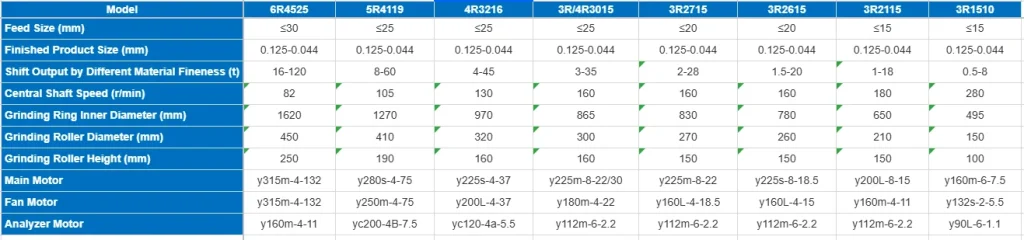
Main specifications of the Raymond mill: