- The double-roll crusher offers advantages such as compact size, a high crushing ratio (5–8), high crushing capacity, low noise, simple structure, and ease of maintenance.
- It features uniform product particle size, a low rate of over-crushing, convenient maintenance, sensitive overload protection, and safe, reliable operation.
- In the coal industry, this machine allows raw coal to be crushed directly after the removal of iron and debris—without the need to remove gangue. The resulting product has uniform particle size and a low over-crushing rate, thereby simplifying the coal preparation process and reducing both investment and production costs.
This toothed-roll crusher achieves high productivity by utilizing high-speed rotating, specially designed wear-resistant toothed rolls to fracture material through splitting (in contrast to traditional toothed-roll crushers, which rely on low-speed crushing via compression). The machine comprises a drive system, frame assembly, crushing rolls, a mechanical spring mechanism, and a linkage mechanism. It offers high crushing capacity and features a torque-limiting fluid coupling between the motor and the reducer to prevent power overload; combined with sensor-based overload protection, the system ensures safe and reliable operation. The gap between the toothed rolls is hydraulically adjustable, and the roll bearings feature centralized lubrication. The tooth profile is optimized for efficiency and low energy consumption, utilizing a combination of tensile and shear forces to achieve uniform product sizing.
- Toothed Roll Crusher: This type features a toothed surface structure designed to crush material through compression and impact. It is suitable for crushing hard and medium-hard materials, such as coal and ore.
- Double Roll Crusher: This machine consists of two parallel, counter-rotating rolls, typically with smooth surfaces. It is suitable for crushing medium-hard and brittle materials, such as limestone and gypsum.
- Four-Roll Crusher: This machine comprises four rolls, which may have either toothed or smooth surfaces. It is generally used for crushing high-hardness materials, such as ore and metallurgical slag.
- Drum Roll Crusher: A specialized type of roll crusher that utilizes cylindrical rolls for crushing. It is typically used for processing finer materials, such as granular coal or fertilizers.
The roller shell has a single-side thickness of 110 mm. Maintenance—specifically machining the roller surface or replacing the shell—is required if the maximum wear on one side reaches 6 mm over an area exceeding 30%, or if the crushed material particle size exceeds production standards. The grinding rollers are equipped with replaceable wear-resistant liners, offering advantages such as a long service life and ease of maintenance.
Components such as bearings, couplings, gear reducers, and motors require regular centralized or manual lubrication, with detailed records maintained (e.g., lubricating couplings every 15 days and motors once a month). Roller gap adjustments must be performed by designated personnel (such as a shift supervisor); safety checks are required prior to adjustment, and relevant valves must be closed afterward. Operators are strictly prohibited from making unauthorized adjustments.
During each shift, operators must continuously adjust the material distribution device to ensure material spreads evenly across the rollers; this promotes uniform wear and prevents the formation of deep grooves, thereby extending the equipment’s service life. For equipment such as four-roller crushers, an “active-standby” configuration is typically employed; the standby unit must be kept in good working order, and there are strict time limits for the maintenance cycle of rollers removed from service (e.g., a maximum of 15 days).
- Strengthen iron removal from the feed material. Foreign objects (such as drill bits) falling between the rolls can damage the crusher and cause unplanned shutdowns; therefore, an iron removal device should be installed upstream of the crusher.
- Sticky materials tend to clog the crushing zone. Clear any blockages only after stopping the machine; never attempt to dislodge material while the crusher is running.
- When processing material containing a large proportion of oversized chunks, be aware that large pieces of ore can be ejected from the crushing zone; take precautions to prevent injury to personnel or damage to equipment.
- After prolonged operation, significant wear on the roll surfaces may result in an excessively fine product size; in such cases, adjust the discharge opening or perform equipment maintenance.
- Enhance equipment inspections and lubricate designated points on schedule to ensure the equipment remains well-lubricated.
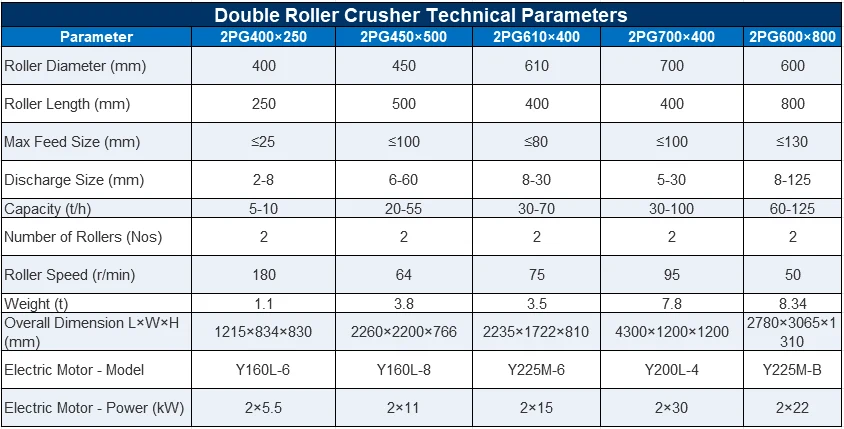
Key Specifications